

Solving problems with pelleting - free guide
Free guide on solving problems with pelleting on small pellet mills
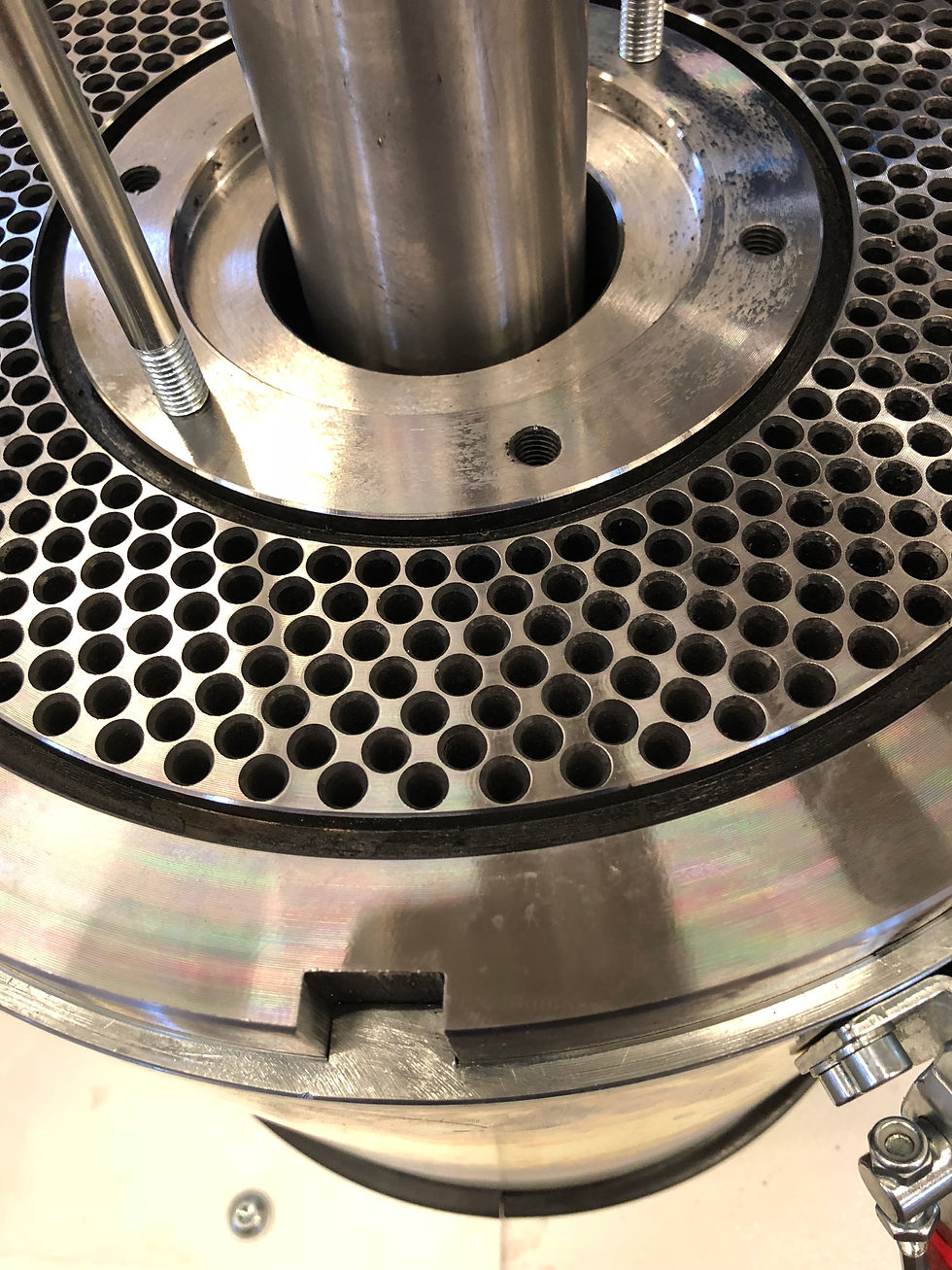
Here we offer a free troubleshooting section to resolve issues with your pelletizer and production line.
Don't waste time on downtime—optimize your process with us. Sign up for our newsletter for technical tips, exclusive promos, and expert solutions.
Have any questions? Use the contact form in our website footer.
We are here to support your business and share our professional knowledge!


The list of possible problems and solutions when pellet mill doesn't act the way you want

No raw material in the pellet mill's buffer tank (applies to full automation)
Fill the buffer tank above the sensor minimum.
Level sensor failure in the pellet mill's buffer tank (applies to full automation)
Check the status and replace the sensor if necessary.
Alarm not reset in the computer (applies to full automation)
Reset the alarm and log it in the failure report journal.
Emergency stop/start switch is turned off
Turn on the switch - remove the padlock and turn the knob to the right position.
Electrical distribution board
Check thermal switches. Check fuses.
Not all line devices are turned on (applies to full automation)
Check if the pellet receiving devices are operational.
Lock – Emergency switch
Unlock the switch (optional for additional drive, e.g., conditioner).
Mechanical blockage between the die and rollers
Check if there is compressed material or other (metal) between the roller and die and remove it; if difficult, loosen the roller assembly and start impulsively (option for trained staff—stay clear of the granulation assembly—exercise caution).
Die with wrong parameters or not broken-in
Check die parameters or break it in (mixture: 50kg sawdust (bran) + 6-10 L vegetable oil (machine oil) + 10-15kg high-grade electrocorundum, grit 70 (200-250 microns)).
Metal pressed into the die
Remove metal or send the die for regeneration.
Rollers too close/coupled
Back off from the die by 0.05 - 0.1 mm.
Damaged roller
Replace the set of rollers.
Damaged thrust bearing of the rotating shaft (cracked)
Call service.
Pelleting assembly overloaded with too much raw material feed
Reduce the amount of raw material feed.
Raw material with parameters other than required entering under the die
Check raw material (whether a change in species or fraction—dust—occurred).
Excess of fed raw material
Limit the raw material feed.
Worn roller shells
Replace roller shells.
Damage to the thrust bearing or roller bearings. Gearbox failure
Call service after inspection.
Incorrect raw material fraction (particles size)
Check the screens and hammers of the grinding mill; if worn, replace immediately and order at least one new original set.
Metal pressed into the die
Remove by punching out or drilling.
Incorrectly set or worn scrapers
Adjust or replace scrapers
Excessive fat in the mixture for animal feeds
Change the recipe; back the rollers away from the die gradually by 0.5 mm.
Change of recipe or raw material
Install a die suitable for the specific recipe, with correctly selected hole diameter and working thickness (compression ratio).
Incorrect die selected for the medium
Check and replace—select the appropriate compression ratio.
Damaged die (dented/blocked)
Order regeneration (refurbishment of die).
Worn die and rollers
Replace worn die and rollers.
Excessive distance between rollers and die. High vibrations
Set rollers correctly.
Supply voltage drop
Check phase and line-to-line voltage.
Poorly tightened wires in the main motor box, on the contactor, or faulty wires
Tighten and check if wires are heating up; replace if necessary.
BIOMASS: Incorrect raw material moisture
Check raw material moisture after leaving the dryer or at the production line inlet (mills and hopper); adjust moisture to 12% ± 1% (determined experimentally).
Incorrectly set or worn rollers
Check the settings; replace worn rollers.
Worn or damaged die (dented/rolled holes)
Replace or order regeneration.
Incorrect compression ratio for the raw material
Check and replace or change the raw material (recommended mixtures).
Worn rollers and die.
Replace rollers and die with new ones (do not replace only one—replace the entire set); order a new original set of consumables immediately.
Raw material parameters poorly matched to the installed die
Coarse material: frayed, short pellets, high fines. Wet material: frayed, longitudinal cracks, swollen, high fines. Change species/proportions or check for contamination (sand, glue, bark—ash content should be < 1.2%).
Excessive feed rate of the medium
Reduce the amount of medium being fed.
Worn or poorly adjusted scrapers
Improve adjustment or replace scrapers; order a new original set immediately.
Compression ratio too low
Use a die with holes that have a longer working section.
Raw material temperature too high
Establish moisture at a correct, stable level.
Raw material parameters poorly matched to the installed die
Dusty material: dark/burnt pellets. Over-dried material: dark/burnt pellets. Check for contamination (sand, glue, bark—ash content < 1.2%).
Partially dented/blocked die holes
Regenerate or replace the die.
Change in raw material parameters (different species or quantity of ingredients, contamination)
Apply an additional component. Provide material intended for the installed die or change the die to match the material.
Low feed rate of the medium
Increase the feed rate of the medium.
Compression ratio too high
Coarse material: frayed, short pellets, high fines. Wet material: frayed, longitudinal cracks, swollen, high fines. Change species/proportions or check for contamination (sand, glue, bark—ash content should be < 1.2%).
Damaged bearings
Check and replace—call service.
Raw material parameters poorly matched to the installed die
Dusty material: dark/burnt pellets. Over-dried material: dark/burnt pellets. Check for contamination (sand, glue, bark—ash content < 1.2%).
Incorrect die for the specific medium
Check compression ratio or change the medium (recipe).
Damaged lubrication system or wrong grease
Check and replace.
Worn scrapers
Check and replace.
Worn rollers and die
Check and replace.
Incorrectly adjusted scrapers
Adjust the scrapers correctly.
Incorrect die
Check and replace (compression ratio too high). Change material parameters (increase particle size).
Poorly adjusted rollers
Move rollers closer (0.1–0.4 mm).
Raw material temperature too low when entering the die
Raise the temperature above 30°C.
Raw material too dusty
Replace screens in the mill with larger mesh.
Change in raw material properties
Check and replace or change raw material (use recommended mixtures with fixed proportions).
Change in material properties causes output to fluctuate
Stabilize output and adjust knives for optimal pellet length (2–3 diameters for feed, 10–40 mm for biofuels).
Worn/poorly adjusted scrapers causing uneven distribution under rollers
Replace or improve adjustment.
One or more rollers are seizing/locking
Check and replace.
Excessive distance between rollers and die
Reduce the distance.
Worn rollers or die
Replace.
Uneven moisture content in the medium
Mix and equalize moisture.
Variable raw material parameters (e.g., fraction)
Check and adjust to raw material.
High raw material moisture
Verify if parameters match assumptions. 40) Reduce moisture, add a component (e.g., CaO or halloysite sorbent up to 3%—biofuels only).
Excessive feed of the medium/material
Limit the feed rate.
Low granulator load
Increase the feed rate.
Incorrect die
Establish correct compression ratio for the feedstock.
Improperly adjusted rollers
Adjust roller position relative to the die according to instructions.
Scrapers worn or poorly set
Adjust or replace.
Material contaminated with sand, glue, high bark content, etc.
Check ash content (allowable < 1.22%; optimal 0.8%; ideal < 0.55%).
Metal fragments pressed into the die
Check/clean all magnetic separators. Check buffer tank and screw feeders. Adjust destoners and airflows in the line.
Lack of or poor lubrication
Check lubrication system. 43) Check grease quality. 44) Check for pump errors; refill if empty.
Asymmetric feedstock dosing
Adjust scrapers or replace worn ones.
Bearing play on the roller axis or shell
Check and replace.
Play on the main shaft
Check and eliminate (service).
Damaged lubrication system or seals
Check and replace.
Poor die/roller design for the feedstock
Check and replace.
Low bearing quality
Use SKF, FAG, or other high-quality bearings.
Lack of or poor lubrication
Check lubrication system. 43) Check grease quality. 44) Check for pump errors; refill if empty.
Improperly adjusted rollers
Adjust rollers according to instructions (> 0.1 mm).
Poor/no contamination separation
Check operation of impurity separators.
Frequent overloading
Reduce loads. Check die, material parameters, and contamination.
Worn bearings
Replace—order service repair.
Excessive force during bolt tightening
Use a torque wrench—strength grade 8.8 bolts only (for miniPelleter)
Frequent tightening and unscrewing
Optimize activities; use thread locker glue.
Installing parts with high temperature differences
Equalize temperatures of assembled parts.
Worn components, play in the die seat, or cracked shaft disk
Replace by trained staff or call service.
Pellet mill's vibrations
Change recipe or add a component.
Incorrect die for the material
Check—replace or change recipe/material.
Rollers too far from the die
Adjust rollers (move closer; gap 0.1–0.2 mm).
Worn bearings, play
Replace—order service repair; eliminate play.
Lack of grease
Refill grease.
Excessive belt tension
Adjust belt tension (for belt driven units)
Frequent overloading (shear pins breaking)
Check for possible causes; reduce load.
Very hard pellets
Change recipe or add a component. Shorten working length of the die.
Excessive overloading
Replace bearings — order service repair
Loose bolt connections
Ensure bolts are tightened properly.
Lack of grease
Refill grease.
Excessive assembly overloading
Replace—order service repair.
Loose bolt connections
Ensure bolts are tightened properly.
Frequent medium parameter changes
Use raw material with stable parameters/recipes.
Damaged/coupled bearings
Replace bearings (by trained staff or service).
Incorrect die for the medium
Replace the die with correct one.
Hard, cold "crust" left under rollers after session
After processing difficult medium, preserve the die with a 4–6% oil mixture.
Result of high overloads, vibrations, play, poor assembly, or non-original parts.
Avoid overloads. Use original parts.
Contamination, wrong moisture, play in the die seat.
Use clean feedstock with right moisture.
Poor compression ratio or unsuitable material for the die
Check material structure/moisture (too dusty or too coarse)
Excessive play in main shaft bearings
Raw materials contaminated with metal or stones.