
Wood Cat Litter Pellets: How to Build a Scalable Biomass Business with a Pellet Machine


The global cat litter market was valued at USD 4.6 billion in 2023 and is projected to reach USD 6.8 billion by 2030 (Grand View Research). Within this market, wood-based cat litter pellets are the fastest-growing segment — driven by pet owner demand for natural, biodegradable, low-dust alternatives to clay litter.
For biomass pellet producers, this represents a high-margin diversification opportunity. Wood cat litter pellets retail at €400–800+/ton in European markets — compared to €150–200/ton for standard heating pellets — using the same raw materials and machinery.
Why Wood Cat Litter Pellets Are a Growing Commercial Opportunity
The shift from clay to wood-based cat litter is driven by:
• Environmental: wood pellets are biodegradable and compostable; clay is strip-mined and non-recyclable
• Health: wood pellets produce 95% less dust than clumping clay — important for cats and owners with respiratory sensitivity
• Performance: wood pellets absorb 2–3× their weight in moisture and neutralise ammonia odour naturally
• Premium pricing: wood cat litter pellets retail at €4–8/kg vs. €0.80–1.50/kg for clay — 5–10× price difference
Product | Retail Price (EU) |
Standard heating pellets (EN 17225) | €0.25–0.32/kg |
Premium wood cat litter pellets | €0.50–0.80/kg |
Branded private-label cat litter | €0.70–1.20/kg |
Raw Material Selection and Preparation for Cat Litter Pellets
Wood cat litter pellets have more demanding raw material specifications than heating pellets:
• Raw material: softwood sawdust preferred (pine, spruce, fir) — natural pine oil contributes to odour control
• Particle size after grinding: 2–4 mm — finer than heating pellets for better surface finish
• Moisture content: 12–15% — same as heating pellets, but more critical for absorbency
• Absence of bark, glues, or preservatives: critical for product safety and certification
Important preparation factors:
• Magnetic separation mandatory: prevents metal particles in a product that contacts pet food/litter areas
• Consistent batch composition: mixing wood species changes pellet density and odour profile
• No recycled wood or MDF: contains formaldehyde — unacceptable for animal contact products
Pellet Production Process for Cat Litter Pellets
1. Material Conditioning
Pine sawdust is conditioned to target moisture of 12–14% — slightly lower than heating pellets to maximise absorbency in the final product. If moisture exceeds 15%, pellets become too soft and may crumble in packaging.
2. Pelletizing with Biomass Pellet Machine
Typical production specifications:
• Die diameter: 6 mm or 8 mm — 6 mm produces a more premium appearance preferred by retail customers
• Compression ratio: L/D 1:5–1:6 for pine sawdust
• Pellet length: 15–25 mm — longer pellets preferred for cat litter (slower breakdown)
• Pellet density: 600–680 kg/m³ — ensures adequate absorbency without excessive weight
3. Cooling and Quality Check
After cooling to ambient temperature, test for:
• Durability: ≥96% (EN 15210) — pellets must survive bagging, shipping, and customer handling
• Moisture: ≤10% final — critical for shelf life and absorbency performance
• Length consistency: CV <15% — important for premium retail presentation
Scaling from Small to Commercial Production
Scale | Daily Output |
Small farm / local | 100–500 kg/day |
Regional distribution | 0.5–3 t/day |
National distribution | 3–20 t/day |
Export / B2B supply | 20+ t/day |
Frequently Asked Questions — Wood Cat Litter Pellets
❓ How are wood cat litter pellets made?
✔ Wood cat litter pellets are made by grinding dry softwood sawdust to 2–4 mm, conditioning to 12–14% moisture, then compressing through a pellet mill ring die (typically 6–8 mm diameter, L/D 1:5–1:6). The pellets are cooled and screened before packaging.
❓ Are wood cat litter pellets better than clay litter?
✔ Wood pellets offer better environmental credentials (biodegradable, lower carbon footprint), produce less dust, and neutralise ammonia more effectively. They are less convenient for some users as they do not clump — but flushable wood litter is gaining popularity rapidly.
❓ What is the profit margin for wood cat litter pellet production?
✔ At scale, gross margins of 70–80% are achievable — significantly higher than heating pellets (50–65%). Net margins after packaging, logistics, and distribution typically range 25–45%.
Conclusion: Building a Scalable Pellet Production Model
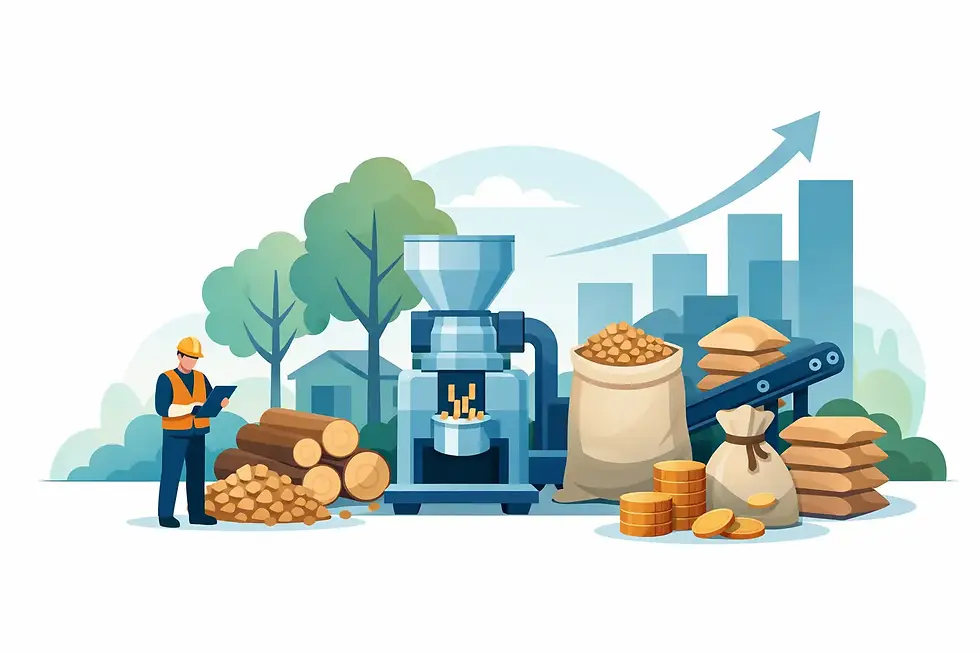
Wood cat litter pellet production represents a practical way to move from raw biomass to a more structured and valuable output. With proper material preparation, efficient processing, and the right pellet machine, businesses can achieve stable and scalable production.
By focusing on consistency and process control, this approach supports long-term growth and improved operational efficiency.


Comments